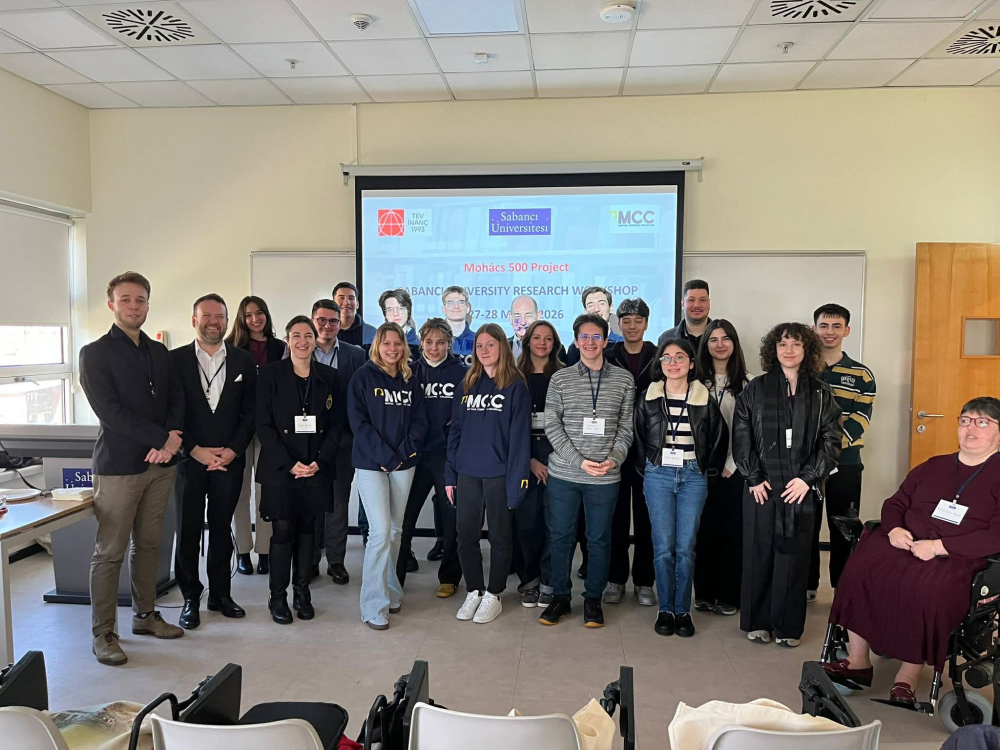

The English-language volume Mohács 500 Dialogue – Centuries of Conflict and Connections has been published, presenting the results of the Mohács 500 Dialogue research and talent development project carried out in cooperation between the MCC Learning Institute, the MCC High School Programme, and TEV İnanç Türkeş Özel Lisesi in Turkey.
The volume was produced as the final outcome of a twelve-month Hungarian–Turkish academic collaboration. The project involved four international student groups, with a total of sixteen secondary school students working on shared research topics under the guidance of teachers, mentors, historians, and history education experts. The aim of the programme was not to construct a single unified historical narrative, but rather to create a professional dialogue in which participants could compare sources, questions, and differing historical perspectives.
The volume examines historical, memory-related, and cultural issues connected to Mohács from multiple perspectives. The research covers, among others, the communication and command challenges of the Battle of Mohács, the diplomatic and intelligence networks of the 1683 Siege of Vienna, early Turkish–Hungarian cultural relations, and the history of Hungarian political emigration to the Ottoman Empire after 1849. The studies demonstrate that the shared past cannot be interpreted solely as a history of wars and conflicts, but also as a history of cultural interactions, personal encounters, diplomatic relations, and competing memories.
The project is closely linked to the history education and international cooperation research of the MCC Learning Institute. One of the key objectives of the programme was to explore how history education can contribute to international dialogue, the development of historical consciousness, and the understanding of different national perspectives. The volume also demonstrates that, with appropriate academic support, talented secondary school students are capable of engaging in university-level research work.
The volume was presented at the project’s closing conference in Budapest, where the student groups presented their research findings in English. Historians, education researchers, teachers, and students jointly reflected on the interpretation of shared historical pasts and the role of international educational cooperation.