September 20 is World Children’s Day. The occasion primarily draws attention to children’s well-being, development and rights, but it also provides an opportunity to ask a question from the perspective of education: what do young people need in order to truly fulfil their potential?
The question goes beyond what knowledge students acquire at school. The UN Convention on the Rights of the Child states that one of the aims of education is to develop the child’s personality, talents and mental and physical abilities to their fullest potential. Achieving this requires more than acquiring knowledge. Young people also need opportunities to think independently, ask questions, work with others, make decisions and test themselves in new situations.
This is why project-based, inquiry-based and experiential learning are receiving increasing attention in educational research. These approaches involve different methods, but they share an important feature: students do not simply receive information; they actively work with it. They ask questions, search for sources, identify connections, consider possible solutions, collaborate with others and use the knowledge they have acquired in concrete tasks.
The OECD’s 2025 work on creative thinking suggests that project work connected to real-world problems and combining knowledge from different fields can provide opportunities to practise creative problem-solving and collaboration. At the same time, research also warns that project work in itself does not guarantee better learning outcomes. Well-designed tasks, appropriate background knowledge, clear objectives, teacher or mentor support and feedback are at least as important as the method itself.
A similar approach can be found in the StarT programme initiated by Finland’s LUMA Centre and reflected in the work of the Teaching and Learning Natural Sciences Research Group of the Hungarian Academy of Sciences and the University of Szeged. The initiative brought together project-based, inquiry-based and phenomenon-based learning, placing particular emphasis on interdisciplinary thinking, collaboration and learning opportunities beyond the classroom.
Several programmes of the MCC Learning Institute approach the same question from a practical perspective. The Twinning Program, the Mohács 500 Dialogue and the MCC Heptathlon focus on different topics and age groups, but they share a common feature: participants do not simply receive knowledge. They conduct research, work together, make decisions and encounter new situations – in other words, they actively use what they have learned.
Learning Together Across Cultures – Twinning Program
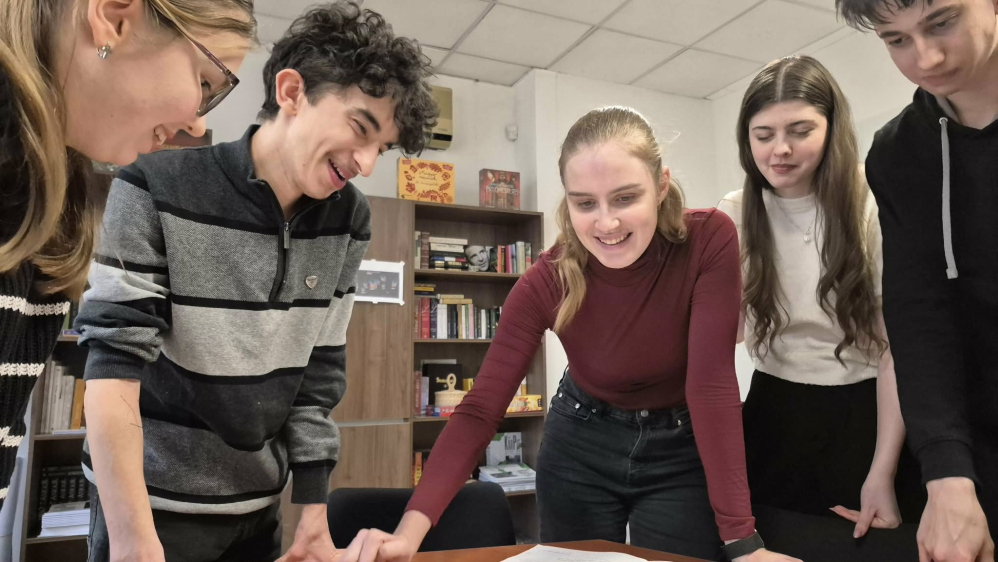
International projects offer a dimension of learning that can be difficult to create in traditional educational settings. When young people from different cultural backgrounds work together, they learn not only about the research question at hand. They must continuously coordinate with one another, understand different perspectives and, in many cases, reconsider assumptions that they had previously taken for granted. The year-long Twinning Program of the MCC Learning Institute was built around joint research conducted by MCC university students and Asian students studying in Hungary. Participants worked together on academic topics and subsequently presented both their research findings and the experiences they had gained throughout the project. One of the programme’s important aims was to bring students from different cultural and educational backgrounds closer together through joint academic work. When discussing a research question, it quickly becomes apparent that the same problem is not necessarily approached through the same concepts, assumptions or priorities. This is not a minor aspect of the learning process. The OECD identifies the ability to understand perspectives different from one’s own, engage in intercultural cooperation and navigate an interconnected world as important elements of global competence. In the Twinning Program, these skills did not appear as a separate subject to be taught. Participants had to experience and develop them through their joint work. They divided tasks, made decisions together, presented arguments, negotiated and examined questions from multiple perspectives. Research therefore became both an academic and an intercultural learning process.
A Shared Past, Different Perspectives – Mohács 500 Dialogue
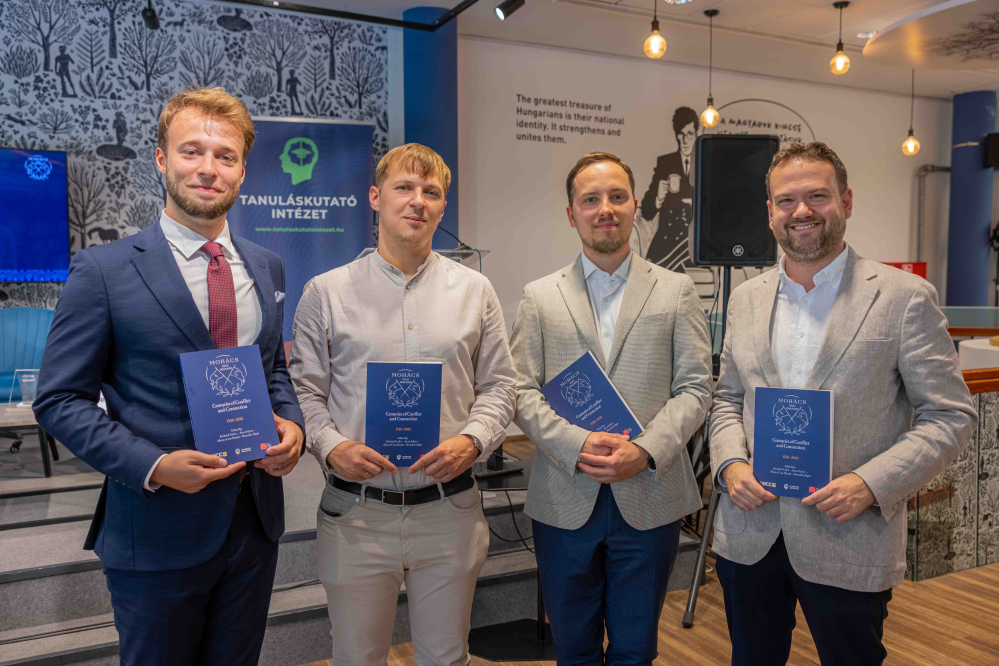
History education is a good example of why knowing facts alone is not enough. Dates, figures and events are, of course, essential, but understanding history also requires students to know how to work with sources, assess their reliability, identify cause-and-effect relationships and compare different interpretations. This was the foundation of the year-long Mohács 500 Dialogue project, organised jointly by the MCC Learning Institute, the MCC Secondary School Programme and the Turkish TEV İnanç Türkeş Özel Lisesi. A total of sixteen secondary-school students worked in four Hungarian–Turkish student groups, conducting joint research with the support of teachers, mentors, historians and experts in history education. The project was centred on the 1526 Battle of Mohács and the shared Hungarian–Turkish past, but the research covered a much broader historical field. Students explored the military and communication aspects of the Battle of Mohács, intelligence networks during the Ottoman–Habsburg conflicts, Hungarian–Turkish historical and cultural connections, as well as the history and memory of Hungarian émigrés in the Ottoman Empire. During the joint work, Hungarian and Turkish students examined the same historical questions. This gave them an opportunity to compare the sources and interpretations they were familiar with and to explore why the same historical event may appear differently in the historical memory of two countries. This is precisely what makes such a project more than an extended history assignment. Students had to search for and analyse sources, formulate questions, support claims with evidence and present their findings in a way that others could understand. History, in this context, was not about memorising ready-made narratives, but about research and interpretation. The encounter between different perspectives can also strengthen source criticism. When several accounts or interpretations of the same event exist, students cannot simply settle for the first answer they encounter. They need to examine who produced a particular source, when and in what circumstances, for what purpose, and then compare it with other evidence. These questions are important far beyond the study of history. In an information environment where people encounter both reliable and unreliable claims every day, the ability to assess sources has a much broader significance. The English-language volume produced at the end of the project is a tangible outcome of the work of the students and their professional mentors. At the same time, it demonstrates that, with appropriate professional support, secondary-school students can play a meaningful role in complex research projects.
Seven Months, Seven Challenges – MCC Heptathlon
Learning opportunities do not end at the school gates. There are many skills and habits that can be discussed in a classroom but can often only truly be understood when young people have the opportunity to try them out themselves. This idea was at the heart of the MCC Heptathlon, launched jointly by the MCC Learning Institute and the MCC Secondary School Programme. The seven-month initiative challenged participants in seven different areas, ranging from digital detox and physical activity in nature to healthy nutrition, creativity, connecting with their roots, community service and finding new solutions. An important element of the programme was that participants were not simply given information about these topics. The challenges were built around action. Talking about conscious digital-device use, for example, is different from actually experiencing the difficulties involved in trying to change one’s own screen-use habits. The same applies to regular exercise, lifestyle choices and community engagement. Such tasks also put independence to the test. Participants need to set their own goals, make decisions, persevere and observe what works for them. A challenge therefore becomes a learning situation not simply because it is unusual or experiential, but because the experience can subsequently be reflected upon: What did I achieve? What was difficult? What should I do differently next time? The nature- and movement-related elements of the Heptathlon also connect to a broader professional question. According to summaries published by Natural England, an increasing body of research examines the relationship between time spent in natural environments, physical activity and well-being. At the same time, caution remains necessary when evaluating the evidence, as different programmes measure their effects on participants in different ways. For this reason, an important next step for such initiatives is not only implementation, but also examining which elements work most effectively, for which participants and under what circumstances. The final stage of the programme focused on creativity. The OECD’s work on creative thinking suggests that creativity should not be understood solely as artistic talent. It also involves generating new and original ideas, exploring different possible solutions and developing existing ideas further. These abilities are needed not only in artistic creation but also when addressing scientific, social or everyday problems. Creative tasks are therefore not simply more colourful elements of an educational programme. They can give young people opportunities to experiment with multiple solutions, take risks, improve their initial ideas and discover that a problem does not always have a single predetermined path to a solution.
What Do the Three Programmes Have in Common?
The Twinning Program, the Mohács 500 Dialogue and the MCC Heptathlon differ considerably in terms of their content. One is an international research collaboration, another focuses on the joint exploration of historical topics, while the third offers challenges related to lifestyle, community and creativity. Yet several elements are present in all three.
The first is active participation. Participants are not simply given every step of the process: they have to ask questions, make choices, conduct research or take action themselves.
The second is collaboration. Working together is not merely a practical way of completing a task. Young people also experience how to divide responsibilities, reconcile different ideas, present arguments, reach compromises and take responsibility for a shared outcome.
The third is the application of knowledge. Analysing a historical source, presenting research findings or designing a personal challenge are all situations in which it is not enough to recall what has previously been learned: knowledge must be applied.
Finally, all three programmes involve some kind of tangible outcome. This may be research, a presentation, a study, a jointly created product or a personal experience. The task is therefore not completed merely because it has to be “handed in”; it has a purpose, an audience and consequences.
Projects or Traditional Learning? There Is No Need to Choose
It is easy to talk about project-based learning as though it were an alternative to traditional education. Research presents a more nuanced picture. Project work does not automatically make learning more effective. For example, a large-scale study conducted in secondary schools in the United Kingdom found no clear positive effect of the project-based programme studied on academic attainment, while participants and teachers reported perceived benefits in areas such as communication, teamwork, research and independent work.
One important lesson from these findings is that much depends on how a programme is designed and implemented.
This matters because knowledge and active experience are not competitors. It is difficult to ask a good question about a topic about which we know nothing. Sources cannot be analysed without background knowledge of history, and creative problem-solving also requires knowledge from which new connections can be built.
A well-designed project therefore does not replace the transmission of knowledge. Instead, it creates opportunities for students to do something with the knowledge they have acquired. They use it in new situations, test it against the ideas of others, apply it to their own questions or transform it into a jointly created outcome.
The role of the teacher or mentor does not diminish in this process either. On the contrary, independent work requires appropriate frameworks, professional guidance and regular feedback. One of the key questions is precisely how young people can be supported while also being given genuine responsibility for their own work.
The student programmes of the Learning Institute explore practical ways in which acquiring knowledge and applying it can complement one another. In the Twinning Program, this is achieved through international cooperation and joint research; in the Mohács 500 Dialogue, through the comparison of historical sources and perspectives; and in the MCC Heptathlon, through personal and community challenges.
The work does not end with these programmes. New projects currently under development also aim to create further opportunities for students to deepen their knowledge, develop their skills, broaden their perspectives and take an active role in their own learning.
World Children’s Day is a good opportunity to think about education from this perspective as well. The question is not only what we want the next generation to learn, but also what experiences we provide alongside that knowledge.
We learn when we read, pay attention and remember something. But we also learn when we ask questions, conduct research, debate, work together, make mistakes, start again and try to use what we have learned in a situation we have never encountered before. The Learning Institute works to expand these opportunities. Its programmes seek to create learning situations in which acquiring knowledge and gaining personal experience are not separate processes, but reinforce one another.