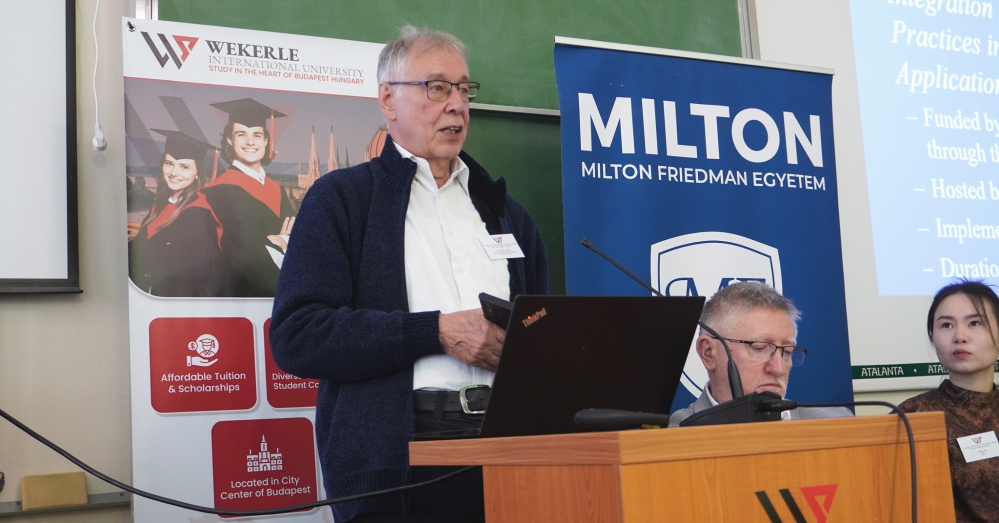
The research project “University–industry integration policies and practices in China – potential applications in Hungary” examines Chinese university–industry integration (UII) policies at the national and provincial levels, as well as related local and institutional practices. The project places special emphasis on the role of university–industry cooperation (UIC) as a strategic instrument for institutional development and higher education reform.
The two-year project is implemented by Wekerle International University (WIU) with funding from the Hungarian Government (through the Tudás-Tér Alapítvány foundation), in close cooperation with the Learning Institute of Mathias Corvinus Collegium (MCCLI). The research is conducted under the professional leadership of a senior researcher from MCCLI and is supported by an international advisory board.
Project objectives
- support Hungarian higher education leaders in designing strategies, governance models, and practical tools to strengthen university–industry cooperation for institutional advancement;
- deepen academic partnerships between Chinese and Hungarian universities, fostering bilateral cooperation and mutual learning, particularly in the field of technological innovation;
- advance the internationalisation of Hungarian higher education.
Conceptual framework
The research is conceptually grounded in theories of knowledge transfer, the university’s third mission, the Triple and Quadruple Helix models, and the Knowledge Triangle. These frameworks are complemented by distinctive Chinese approaches to university–industry integration, which place strong emphasis on strategic coordination between higher education institutions, industry, and public authorities.
Special attention is given to bi-directional and reverse knowledge transfer, highlighting models in which knowledge flows not only from universities to industry, but also from industry to academia. In this context, UIC is analysed as a key driver of university modernisation and organisational change.
The project applies a broad interpretation of “industry”, encompassing not only traditional manufacturing sectors but also services, technology-intensive fields, and the creative industries, thereby addressing the full spectrum of the university’s third mission.
Methodology
- The project follows a qualitative research design, combining:
- policy document and literature analysis;
- institutional and city-level case studies of UII policies and practices in selected Chinese regions;
- hybrid-format workshops and academic conferences supporting knowledge exchange.
Empirical research focuses particularly on business studies, engineering, and creative industries, ensuring sectoral diversity and analytical depth. Elements of action research are integrated into the project to facilitate the immediate application of research findings to institutional development processes at WIU.
Expected outcomes
The project will deliver:
- a series of expert and analytical reports;
- detailed case studies on Chinese university–industry integration practices;
- academic publications;
- a practical toolkit for higher education leaders on using UIC for institutional development;
- and a concluding international conference aimed at fostering new and sustainable partnerships between Chinese and Hungarian universities.
Through these outputs, the project seeks not only to contribute to academic knowledge but also to stimulate tangible institutional change, supporting innovative and sustainable models of university–industry cooperation in both national and international contexts.